Second Turks March
From Aird's Selection of Scotch, English, Irish and Foreign Airs, vol. II (c. 1782), no. 7, p. 3
Your PDF is on its way. Want the next free piece too? About one email a month, with printable carols when you join.
We send a link to confirm first. Your address is used for this list and nothing else. Privacy
How to practise it
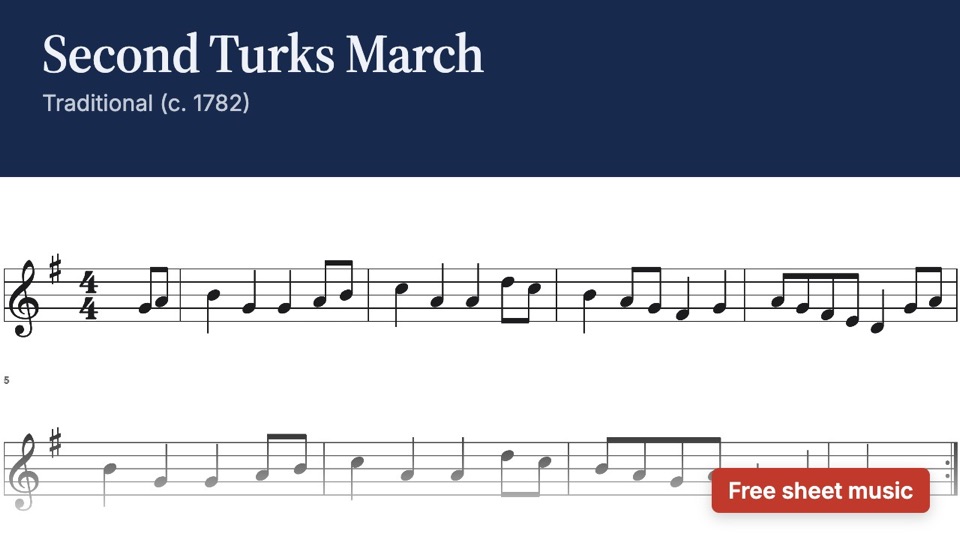
A single melody line from a book of tunes for fife, violin or flute, played on the piano by the right hand alone. Most of the tune moves in crotchets and pairs of quavers; the busiest bar is 12, eight straight quavers, and bar 10 has the tune's only accidental, an F♮ near the end of the bar. Keep a steady march beat, four to a bar, and note that bars 14–21 repeat the opening bars 1–8 almost note for note, so the second half is half learnt already. Both halves are repeated, and each begins with a two-note pickup.
This version follows the tune as printed, as "2d. Turks March", in James Aird's Selection of Scotch, English, Irish and Foreign Airs (Glasgow), volume II, about 1782. Source: archive.org
Second Turks March is a traditional tune, set for solo piano, from Aird's Selection of Scotch, English, Irish and Foreign Airs, vol. II (c. 1782), no. 7, p. 3. It is in G major, in 4/4 time and at 144 beats a minute, and under a minute played straight through, longer with the repeats. Level: Beginner, worked out from the notes (a tune with a simple bass or none, unhurried, in an easy key). Free here, with no account: hear it played, follow the score as it plays, print it as a PDF, open the original public-domain engraving and watch it played.
Beginner piano pieces, easiest first
Watch it played
The notes light up as they sound. The video's own page, with its chapters · Watch on YouTube
More in the playlist: Piano Sheet Music — Play AlongSubscribe on YouTube
The Gong Logic email list
About one email a month: new free sheet music, stories to read and what is in season. Free downloads when you join; leave with one click.
We send a link to confirm first. Your address is used for this list and nothing else. Privacy