There's Music in the Air
Your PDF is on its way. Want the next free piece too? About one email a month, with printable carols when you join.
We send a link to confirm first. Your address is used for this list and nothing else. Privacy
How to practise it
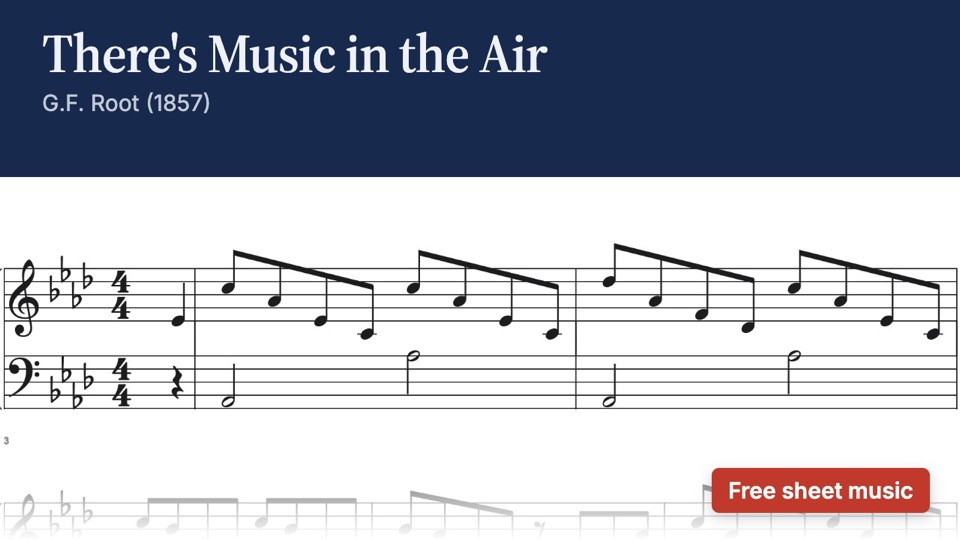
The piano introduction (bars 1–8) is a running line of right-hand quavers over two left-hand notes a bar: keep the quavers even and let them lead into the singer's entry on the last beat of bar 8. From bar 9 the right hand plays chords after crotchet rests, over left-hand octaves (A♭1–A♭2 in bars 9–10 and 13–14); keep the chords light and exactly on the off-beat, as the rests give the rhythm its lift. At bar 17 the right hand jumps more than two octaves, up to F6, and plays quaver arpeggios high above the staff on ledger lines; practise the move from the end of bar 16 on its own, and read the high notes before playing them. Bars 11–18 are repeated for each verse.
Root wrote both the words and the music; IMSLP gives 1857 as the year of first publication. Source: IMSLP
There's Music in the Air is a piece for voice and piano by G.F. Root (1857). It is in A♭ major, in 4/4 time and at 120 beats a minute, and about a minute played straight through, longer with the repeats. Level: Easy, worked out from the notes (both hands busy but mostly one note at a time, at a steady speed, with few accidentals). Free here, with no account: hear it played, follow the score as it plays, print it as a PDF, open the original public-domain engraving and watch it played.
Easy songs for voice and piano, easiest first
Watch it played
The notes light up as they sound. The video's own page, with its chapters · Watch on YouTube
More in the playlist: Piano Sheet Music — Play AlongSubscribe on YouTube
The Gong Logic email list
About one email a month: new free sheet music, stories to read and what is in season. Free downloads when you join; leave with one click.
We send a link to confirm first. Your address is used for this list and nothing else. Privacy