Rodney's Glory
From O'Neill's Music of Ireland (Chicago, 1903), no. 27, p. 5
Your PDF is on its way. Want the next free piece too? About one email a month, with printable carols when you join.
We send a link to confirm first. Your address is used for this list and nothing else. Privacy
How to practise it
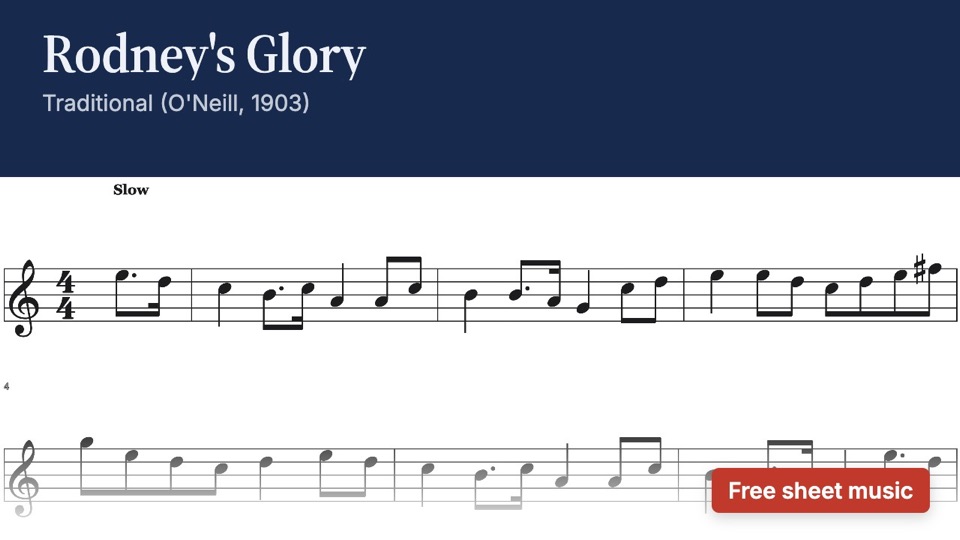
This is a single melody line, a slow air marked Slow, so on the piano it is played by the right hand alone. Its dotted quaver and semiquaver pairs (bars 1–2, 5–6 and 17–19, for example) should lean on the long note and let the short one fall lightly, never snapped. Bar 15 climbs to the top of the tune, a held A5 and then B5, and bars 3, 10 and 12 bring in F♯, with F♮ two notes later in bar 12; mark both before playing. A new phrase begins on the quaver D of the short bar 9, after a quaver rest.
A slow air named for Admiral Rodney's victory at the Saintes in 1782; this version follows Francis O'Neill's Music of Ireland (Chicago, 1903), no. 27. Source: archive.org
Rodney's Glory is a traditional tune, set for solo piano, from O'Neill's Music of Ireland (Chicago, 1903), no. 27, p. 5. It is in A minor, in 4/4 time and at 66 beats a minute, and about 1½ minutes long. Level: Beginner, worked out from the notes (a tune with a simple bass or none, unhurried, in an easy key). Free here, with no account: hear it played, follow the score as it plays, print it as a PDF, open the original public-domain engraving and watch it played.
Beginner piano pieces, easiest first
Watch it played
The notes light up as they sound. The video's own page, with its chapters · Watch on YouTube
More in the playlist: Piano Sheet Music — Play AlongSubscribe on YouTube
The Gong Logic email list
About one email a month: new free sheet music, stories to read and what is in season. Free downloads when you join; leave with one click.
We send a link to confirm first. Your address is used for this list and nothing else. Privacy