Ballade
From 25 Études faciles et progressives, Op. 100 No. 15 (Ballade)
Your PDF is on its way. Want the next free piece too? About one email a month, with printable carols when you join.
We send a link to confirm first. Your address is used for this list and nothing else. Privacy
How to practise it
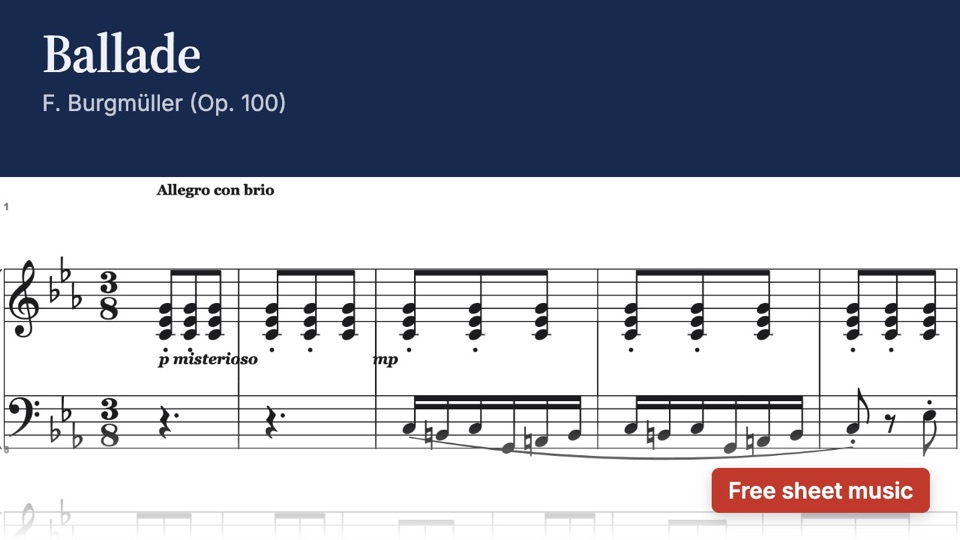
The tune is in the left hand: from bar 3 it plays a quick semiquaver figure (with B♮ and A♮) under the right hand's repeated staccato chords, so practise the left hand alone until that figure is even and clear. The right-hand chords must stay short and quiet, with the F♯ chords of bars 8, 10, 16 and 18 as the only change of shape. The middle section moves to C major at bar 30 and is repeated, and C minor returns at bar 56. Bars 87–90 are the busiest of all, with semiquavers in both hands, and bar 94 is played an octave higher than written (8va).
No. 15 of Burgmüller's 25 Études faciles et progressives, Op. 100, first published in Paris in 1851. Source: IMSLP
Ballade is a piece for solo piano by F. Burgmüller (Op. 100), from 25 Études faciles et progressives, Op. 100 No. 15 (Ballade). It is in C minor, in 3/8 time and at 104 beats a minute, and about 1½ minutes played straight through, longer with the repeats. Level: Intermediate, worked out from the notes (chords, two lines in one hand, faster passages or wider stretches). Free here, with no account: hear it played, follow the score as it plays, print it as a PDF, open the original public-domain engraving and watch it played.
Intermediate piano pieces, easiest first
Watch it played
The notes light up as they sound. The video's own page, with its chapters · Watch on YouTube
More in the playlist: Piano Sheet Music — Play AlongSubscribe on YouTube
The Gong Logic email list
About one email a month: new free sheet music, stories to read and what is in season. Free downloads when you join; leave with one click.
We send a link to confirm first. Your address is used for this list and nothing else. Privacy