Waltz in G major, Op. 39 No. 10
From 16 Waltzes, Op. 39 No. 10
Your PDF is on its way. Want the next free piece too? About one email a month, with printable carols when you join.
We send a link to confirm first. Your address is used for this list and nothing else. Privacy
How to practise it
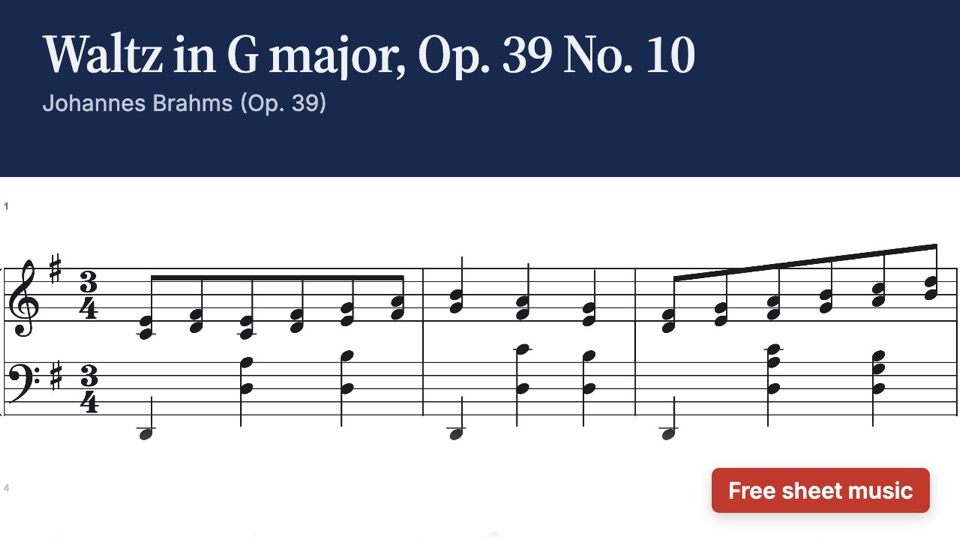
At 160 beats a minute the right hand's quavers in thirds (bars 1, 3, 9 and 11, for example) need a loose hand and a fixed fingering, so practise them slowly until each third sounds as one. Under them the left hand plays a bass note on beat 1 and chords on beats 2 and 3; in bars 18, 20, 26 and 28 it drops to a low F♯ octave and leaps up more than an octave to the next chord, so practise that move alone. Bars 17–20 and 25–28 bring A♯, C♯ and D♯ into the right-hand thirds, and bars 5 and 13 an F♮ in both hands. Bars 22 and 30 hold a dotted note and then dash up in a quick run of short notes before the cadence: count the dotted note fully before the run.
No. 10 of Brahms's 16 Waltzes, Op. 39, composed in 1865, published in 1866 and dedicated to Eduard Hanslick. Source: IMSLP
Waltz in G major, Op. 39 No. 10 is a piece for solo piano by Johannes Brahms (Op. 39), from 16 Waltzes, Op. 39 No. 10. It is in G major, in 3/4 time and at 160 beats a minute, and under a minute long. Level: Intermediate, worked out from the notes (chords, two lines in one hand, faster passages or wider stretches). Free here, with no account: hear it played, follow the score as it plays, print it as a PDF, open the original public-domain engraving and watch it played.
Intermediate piano pieces, easiest first
Watch it played
The notes light up as they sound. The video's own page, with its chapters · Watch on YouTube
More in the playlist: Piano Sheet Music — Play AlongSubscribe on YouTube
The Gong Logic email list
About one email a month: new free sheet music, stories to read and what is in season. Free downloads when you join; leave with one click.
We send a link to confirm first. Your address is used for this list and nothing else. Privacy