Arranged for first and second-year pianists
Easy piano for Easter
The hymns people ask for at Easter, arranged for a pianist in their first year or two. Printable PDFs with fingering marked, to download from the Gong Logic shop (and on Sheet Music Direct). They also come with practice recordings to play along with.
Ten Easter hymns, with practice recordings
From Palm Sunday to Ascension: each hymn for easy piano with the words, and six recordings to play along with, one download.
The whole set, one download
Buy the set · US$24 from Gumroad or buy it from our shop
Easter hymns for beginners, with letter names
The same ten hymns in C, with the letter name under every note, each with six recordings to play along with, one download.
The whole set, one download
Buy the set · US$14.99 from Gumroad or buy it from our shop
With the easy piano set, one download
Buy both · US$29 from Gumroad or buy it from our shop
Easter hymn duets for a student and teacher
Ten hymns for one piano, four hands: the student plays the easy melody, the teacher a full accompaniment. Score, both parts and five recordings each, one download.
The whole set, one download
Buy the set · US$24 from Gumroad or buy it from our shop
The pieces, one by one
-
All Glory, Laud and Honor
-
Melchior Teschner (1584–1635) · 2 pages · 1:00
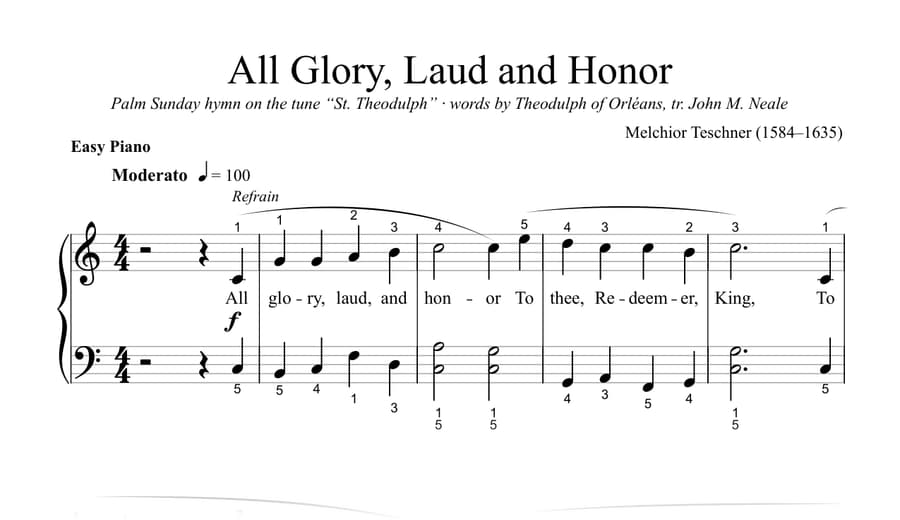
All Glory, Laud and Honor for easy piano, with the words, on Melchior Teschner's tune 'St. Theodulph', in C major. It is laid out as the hymn is sung: the refrain, a verse, and the refrain again. The right hand plays the melody as it is sung, the left hand plays the hymn's own bass line, and there are no sixteenth notes. Fingering, dynamics and phrasing are marked.
Easy piano edition
Buy · US$6.99 from our shop or buy it on Sheet Music Direct
-
Melchior Teschner (1584–1635) · 2 pages · 1:05
All Glory, Laud and Honor for the very first piano lessons, on Melchior Teschner's tune 'St. Theodulph', in C major, laid out refrain, verse, refrain. Every right-hand note has its letter name printed under it, the right hand plays the melody one note at a time in five-finger positions, and each place the hand has to move is marked "move". The left hand plays single bass notes, mostly the hymn's own bass line in quarter notes. Fingering, dynamics, phrasing and a simple tempo word are marked.
Beginner piano, letter names edition
Buy · US$6.99 from our shop or buy it on Sheet Music Direct
-
Melchior Teschner (1584–1635) · 3 pages · 1:10
All Glory, Laud and Honor as a piano duet for a student and teacher at one piano, on Melchior Teschner's tune 'St. Theodulph', in C major. The student (Primo) plays the easy-piano melody with fingering and the words, printed an octave below where it sounds under an 8va line so it reads in the usual place. The teacher (Secondo) plays a full accompaniment on the hymn's own harmony, with a four-bar introduction and a different accompaniment for each refrain and the verse. Includes the full score and a separate part for each player.
Piano duet edition
Buy · US$6.99 from our shop or buy it on Sheet Music Direct
-
-
O Sacred Head, Now Wounded
-
Hans Leo Hassler (1564–1612) · 2 pages · 1:09
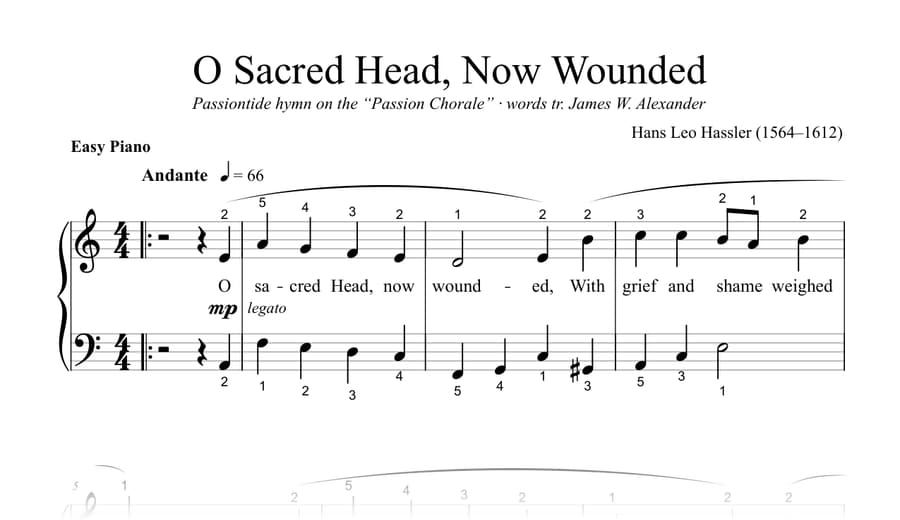
O Sacred Head, Now Wounded for easy piano, with verse 1 lyrics, on the Passion Chorale (Hassler, harmony after J. S. Bach), in A minor. The right hand plays the melody as it is sung. The left hand plays the hymn's own bass line, one note to a beat, with an open fifth on long notes. There are no sixteenth notes. Fingering, dynamics and phrasing are marked. An optional repeat gives a second verse, and the piece closes with a soft echo of the last line.
Easy piano edition
Buy · US$6.99 from our shop or buy it on Sheet Music Direct
-
Hans Leo Hassler (1564–1612) · 2 pages · 1:09
O Sacred Head, Now Wounded for the very first piano lessons, on the Passion Chorale (Hassler, harmony after J. S. Bach), in A minor. Every right-hand note has its letter name printed under it. The right hand plays the melody one note at a time; the hymn is in A minor with no key signature, so every melody note is a white key. Each place the hand has to move to a new position is marked "move". The left hand plays single long bass notes or open fifths. Fingering, dynamics, phrasing and a simple tempo word are marked, with an optional repeat and a short ending.
Beginner piano, letter names edition
Buy · US$6.99 from our shop or buy it on Sheet Music Direct
-
Hans Leo Hassler (1564–1612) · 5 pages · 2:18
O Sacred Head, Now Wounded as a piano duet for a student and teacher at one piano, on the Passion Chorale (Hassler, harmony after J. S. Bach), in A minor. The student (Primo) plays the easy-piano melody with fingering and verse 1 lyrics, printed an octave below where it sounds under an 8va line so it reads in the usual place. The teacher (Secondo) plays a full accompaniment on the hymn's own harmony, with an introduction and a different accompaniment for the second verse. Includes the full score and a separate part for each player.
Piano duet edition
Buy · US$6.99 from our shop or buy it on Sheet Music Direct
-
-
When I Survey the Wondrous Cross
-
Lowell Mason (1792–1872) · 2 pages · 1:03
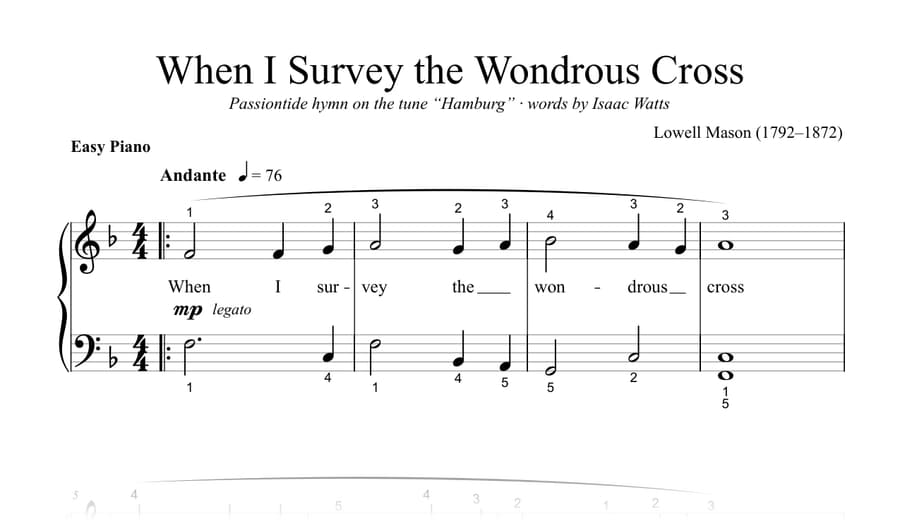
When I Survey the Wondrous Cross for easy piano, with verse 1 lyrics, on Lowell Mason's tune 'Hamburg', in F major. The right hand plays the melody as it is sung. The left hand plays the hymn's own bass in single notes and open fifths, mostly in half and whole notes. There are no sixteenth notes. Fingering, dynamics and phrasing are marked. An optional repeat gives a second verse, and the piece closes with a soft echo of the last line.
Easy piano edition
Buy · US$6.99 from our shop or buy it on Sheet Music Direct
-
Lowell Mason (1792–1872) · 2 pages · 1:03
When I Survey the Wondrous Cross for the very first piano lessons, on Lowell Mason's tune 'Hamburg', in C major. Every right-hand note has its letter name printed under it. The right hand plays the melody one note at a time, moved from F major to C major so every note is a white key. Each place the hand has to move to a new position is marked "move". The left hand plays single long bass notes or open fifths. Fingering, dynamics, phrasing and a simple tempo word are marked, with an optional repeat and a short ending.
Beginner piano, letter names edition
Buy · US$6.99 from our shop or buy it on Sheet Music Direct
-
Lowell Mason (1792–1872) · 4 pages · 2:00
When I Survey the Wondrous Cross as a piano duet for a student and teacher at one piano, on Lowell Mason's tune 'Hamburg', in F major. The student (Primo) plays the easy-piano melody with fingering and verse 1 lyrics, printed an octave below where it sounds under an 8va line so it reads in the usual place. The teacher (Secondo) plays a full accompaniment on the hymn's own harmony, with an introduction and a different accompaniment for the second verse. Includes the full score and a separate part for each player.
Piano duet edition
Buy · US$6.99 from our shop or buy it on Sheet Music Direct
-
-
There Is a Green Hill Far Away
-
William Horsley (1774–1858) · 2 pages · 0:40
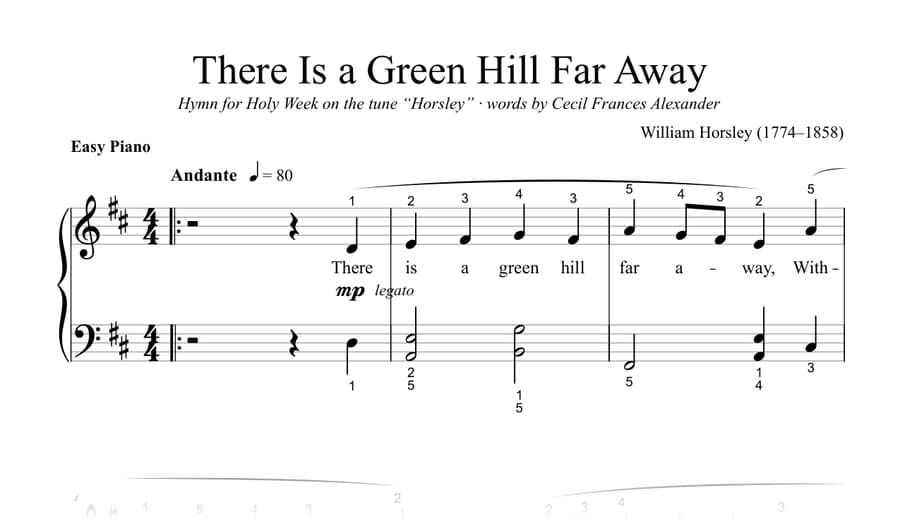
There Is a Green Hill Far Away for easy piano, with verse 1 lyrics, on William Horsley's tune 'Horsley' (words by Cecil Frances Alexander), in D major. The right hand plays the melody as it is sung, the left hand plays the hymn's own harmony in simple two-note chords and single bass notes, and there are no sixteenth notes. Fingering, dynamics and phrasing are marked. An optional repeat gives a second verse, and the piece closes with a soft echo of the last line.
Easy piano edition
Buy · US$6.99 from our shop or buy it on Sheet Music Direct
-
William Horsley (1774–1858) · 1 pages · 0:42
There Is a Green Hill Far Away for the very first piano lessons, on William Horsley's tune 'Horsley', in C major. Every right-hand note has its letter name printed under it, the right hand plays the melody one note at a time in five-finger positions, and each place the hand has to move is marked "move". The left hand plays single long bass notes or open fifths. Fingering, dynamics, phrasing and a simple tempo word are marked, with an optional repeat and a short ending.
Beginner piano, letter names edition
Buy · US$6.99 from our shop or buy it on Sheet Music Direct
-
William Horsley (1774–1858) · 3 pages · 1:20
There Is a Green Hill Far Away as a piano duet for a student and teacher at one piano, on William Horsley's tune 'Horsley', in D major. The student (Primo) plays the easy-piano melody with fingering and verse 1 lyrics, printed an octave below where it sounds under an 8va line so it reads in the usual place. The teacher (Secondo) plays a full accompaniment on the hymn's own harmony, with an introduction and a different accompaniment for the second verse. Includes the full score and a separate part for each player.
Piano duet edition
Buy · US$6.99 from our shop or buy it on Sheet Music Direct
-
-
Christ the Lord Is Risen Today
-
Anonymous, from Lyra Davidica (London, 1708) · 2 pages · 0:44
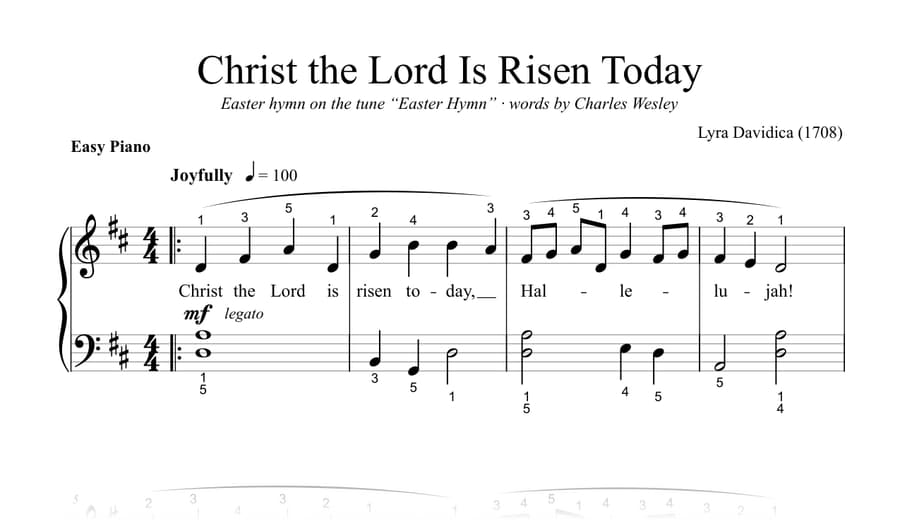
Christ the Lord Is Risen Today for easy piano, with verse 1 lyrics, on the tune 'Easter Hymn' from Lyra Davidica (1708), with Charles Wesley's words and their four Hallelujahs, in D major. The right hand plays the melody as it is sung, the left hand plays the hymn's own harmony in single bass notes and open fifths, and there are no sixteenth notes. Fingering, dynamics and phrasing are marked, with an optional repeat for a second verse.
Easy piano edition
Buy · US$6.99 from our shop or buy it on Sheet Music Direct
-
Anonymous, from Lyra Davidica (London, 1708) · 2 pages · 0:49
Christ the Lord Is Risen Today for the very first piano lessons, on the tune 'Easter Hymn' from Lyra Davidica (1708), with Charles Wesley's words and their four Hallelujahs, in C major. Every right-hand note has its letter name printed under it, the right hand plays the melody one note at a time in five-finger positions, and each place the hand has to move is marked "move". The left hand plays single long bass notes or open fifths. Fingering, dynamics and phrasing are marked, with an optional repeat.
Beginner piano, letter names edition
Buy · US$6.99 from our shop or buy it on Sheet Music Direct
-
Anonymous, from Lyra Davidica (London, 1708) · 4 pages · 1:27
Christ the Lord Is Risen Today as a piano duet for a student and teacher at one piano, on the tune 'Easter Hymn' from Lyra Davidica (1708), with Charles Wesley's words and their four Hallelujahs, in D major. The student (Primo) plays the easy-piano melody with fingering and verse 1 lyrics, printed an octave below where it sounds under an 8va line so it reads in the usual place. The teacher (Secondo) plays an accompaniment on the hymn's own harmony, with an introduction and a different accompaniment for the second verse. Includes the full score and a separate part for each player.
Piano duet edition
Buy · US$6.99 from our shop or buy it on Sheet Music Direct
-
-
The Strife Is O'er
-
Giovanni Pierluigi da Palestrina, adapted by William H. Monk (1823–1889) · 2 pages · 1:00
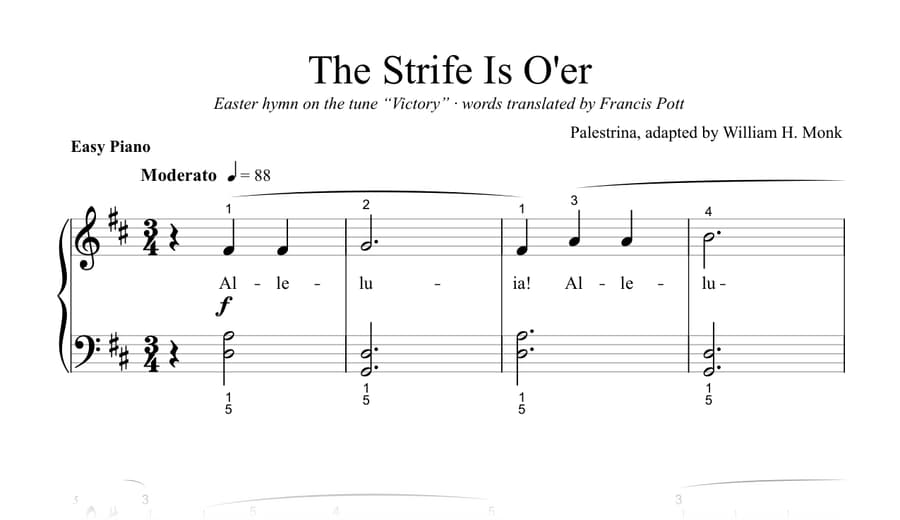
The Strife Is O'er for easy piano, with verse 1 lyrics, on the tune 'Victory' (William H. Monk's 1861 adaptation of Palestrina), with Francis Pott's translation and its Alleluias, in D major. The right hand plays the melody as it is sung, the left hand plays the hymn's own harmony in single bass notes and open fifths, and there are no sixteenth notes. Fingering, dynamics and phrasing are marked, with an optional repeat for a second verse.
Easy piano edition
Buy · US$6.99 from our shop or buy it on Sheet Music Direct
-
Giovanni Pierluigi da Palestrina, adapted by William H. Monk (1823–1889) · 2 pages · 1:06
The Strife Is O'er for the very first piano lessons, on the tune 'Victory' (William H. Monk's 1861 adaptation of Palestrina), with Francis Pott's translation and its Alleluias, in C major. Every right-hand note has its letter name printed under it, the right hand plays the melody one note at a time in five-finger positions, and each place the hand has to move is marked "move". The left hand plays single long bass notes or open fifths. Fingering, dynamics and phrasing are marked, with an optional repeat.
Beginner piano, letter names edition
Buy · US$6.99 from our shop or buy it on Sheet Music Direct
-
Giovanni Pierluigi da Palestrina, adapted by William H. Monk (1823–1889) · 5 pages · 1:35
The Strife Is O'er as a piano duet for a student and teacher at one piano, on the tune 'Victory' (William H. Monk's 1861 adaptation of Palestrina), with Francis Pott's translation and its Alleluias, in D major. The student (Primo) plays the easy-piano melody with fingering and verse 1 lyrics, printed an octave below where it sounds under an 8va line so it reads in the usual place. The teacher (Secondo) plays an accompaniment on the hymn's own harmony, with an introduction and a different accompaniment for the second verse. Includes the full score and a separate part for each player.
Piano duet edition
Buy · US$6.99 from our shop or buy it on Sheet Music Direct
-
-
Low in the Grave He Lay
-
Robert Lowry (1826–1899) · 2 pages · 1:26
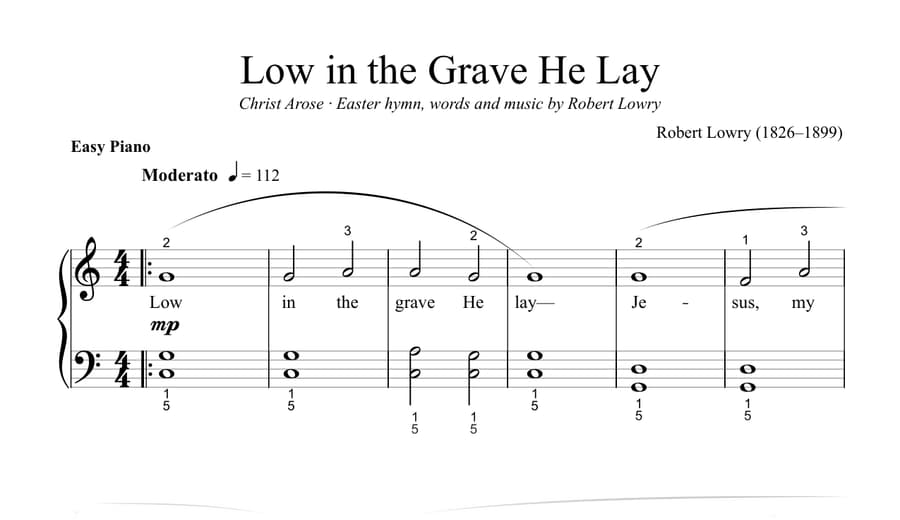
Low in the Grave He Lay (Christ Arose), Robert Lowry's Easter hymn, for easy piano with the words of verse 1 and the chorus, in C major. The note values are doubled from the hymnal, so the chorus's dotted rhythms are written as dotted quarters and eighths and there are no sixteenth notes. The right hand plays the melody as it is sung, the left hand plays the hymn's own harmony in simple two-note chords and single bass notes. Fingering, dynamics and phrasing are marked, the chorus is labelled, and an optional repeat gives verses 2 and 3.
Easy piano edition
Buy · US$6.99 from our shop or buy it on Sheet Music Direct
-
Robert Lowry (1826–1899) · 2 pages · 1:26
Low in the Grave He Lay (Christ Arose), Robert Lowry's Easter hymn, for the very first piano lessons, in C major. Every right-hand note has its letter name printed under it, and the right hand plays the melody one note at a time in five-finger positions; each place the hand moves to a new position is marked. The left hand plays single long bass notes or open fifths. The note values are doubled, so there are no sixteenth notes. Fingering, dynamics, phrasing and a tempo word are marked, with an optional repeat.
Beginner piano, letter names edition
Buy · US$6.99 from our shop or buy it on Sheet Music Direct
-
Robert Lowry (1826–1899) · 4 pages · 1:34
Low in the Grave He Lay (Christ Arose), Robert Lowry's Easter hymn, as a piano duet for a student and teacher at one piano, in C major. The student (Primo) plays the easy-piano melody with fingering and the words of verse 1 and the chorus, printed an octave below where it sounds under an 8va line so it reads in the usual place. The teacher (Secondo) plays a full accompaniment on the hymn's own harmony: an introduction, flowing broken chords under the slow verse and a marching accompaniment under the chorus. Includes the full score and a separate part for each player.
Piano duet edition
Buy · US$6.99 from our shop or buy it on Sheet Music Direct
-
-
Come, Ye Faithful, Raise the Strain
-
Arthur S. Sullivan (1842–1900) · 2 pages · 0:52
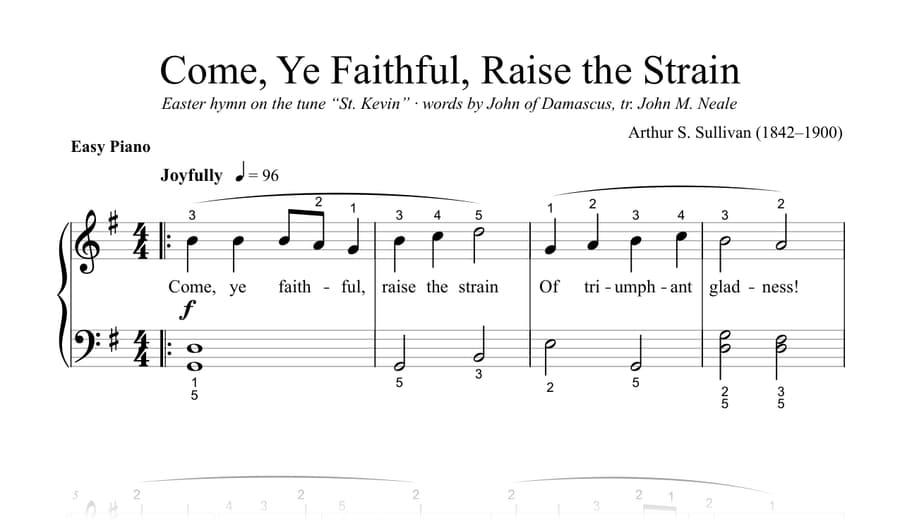
Come, Ye Faithful, Raise the Strain for easy piano, with verse 1 lyrics, on Arthur Sullivan's tune 'St. Kevin' (words by John of Damascus, translated by John M. Neale), in G major. The right hand plays the melody as it is sung, the left hand plays the hymn's own harmony in simple two-note chords and single bass notes, and there are no sixteenth notes. Fingering, dynamics and phrasing are marked. An optional repeat gives a second verse, and the piece closes with a soft echo of the last line.
Easy piano edition
Buy · US$6.99 from our shop
-
Arthur S. Sullivan (1842–1900) · 2 pages · 0:57
Come, Ye Faithful, Raise the Strain for the very first piano lessons, on Arthur Sullivan's tune 'St. Kevin', in C major. Every right-hand note has its letter name printed under it, the right hand plays the melody one note at a time in five-finger positions, and each place the hand has to move is marked "move". The left hand plays single long bass notes or open fifths. Fingering, dynamics, phrasing and a simple tempo word are marked, with an optional repeat and a short ending.
Beginner piano, letter names edition
Buy · US$6.99 from our shop
-
Arthur S. Sullivan (1842–1900) · 4 pages · 1:42
Come, Ye Faithful, Raise the Strain as a piano duet for a student and teacher at one piano, on Arthur Sullivan's tune 'St. Kevin', in G major. The student (Primo) plays the easy-piano melody with fingering and verse 1 lyrics, printed an octave below where it sounds under an 8va line so it reads in the usual place. The teacher (Secondo) plays a full accompaniment on the hymn's own harmony, with an introduction and a different accompaniment for the second verse. Includes the full score and a separate part for each player.
Piano duet edition
Buy · US$6.99 from our shop
-
-
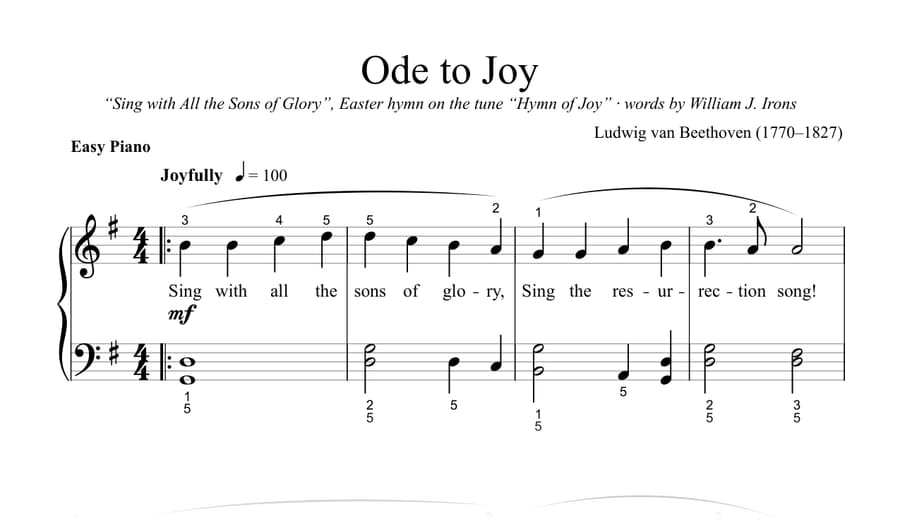
Ode to Joy (Sing with All the Sons of Glory)
-
Ludwig van Beethoven (1770–1827) · 2 pages · 0:48
Ode to Joy, Beethoven's tune from the Ninth Symphony, as the Easter hymn Sing with All the Sons of Glory (words by William J. Irons), for easy piano with verse 1 lyrics, on the hymn tune 'Hymn of Joy', in G major. The right hand plays the melody as it is sung, the left hand plays the hymn's own harmony in simple two-note chords and single bass notes, and there are no sixteenth notes. Fingering, dynamics and phrasing are marked. An optional repeat gives a second verse, and the piece closes with a soft echo of the last line.
Easy piano edition
Buy · US$6.99 from our shop
-
Ludwig van Beethoven (1770–1827) · 2 pages · 0:48
Ode to Joy, Beethoven's tune from the Ninth Symphony, as the Easter hymn Sing with All the Sons of Glory (words by William J. Irons), for the very first piano lessons, in C major. Every right-hand note has its letter name printed under it, and the right hand plays the melody one note at a time in the middle-C five-finger position, moving once, for the low G in 'time shall cease' (each move is marked). The left hand plays single long bass notes or open fifths. Fingering, dynamics, phrasing and a tempo word are marked, with an optional repeat and a soft closing line.
Beginner piano, letter names edition
Buy · US$6.99 from our shop
-
Ludwig van Beethoven (1770–1827) · 4 pages · 1:36
Ode to Joy, Beethoven's tune from the Ninth Symphony, as the Easter hymn Sing with All the Sons of Glory (words by William J. Irons), arranged as a piano duet for a student and teacher at one piano, in G major. The student (Primo) plays the easy-piano melody with fingering and verse 1 lyrics, printed an octave below where it sounds under an 8va line so it reads in the usual place. The teacher (Secondo) plays a full accompaniment on the hymn's own harmony, with an introduction and a different accompaniment for the second verse. Includes the full score and a separate part for each player.
Piano duet edition
Buy · US$6.99 from our shop
-
-
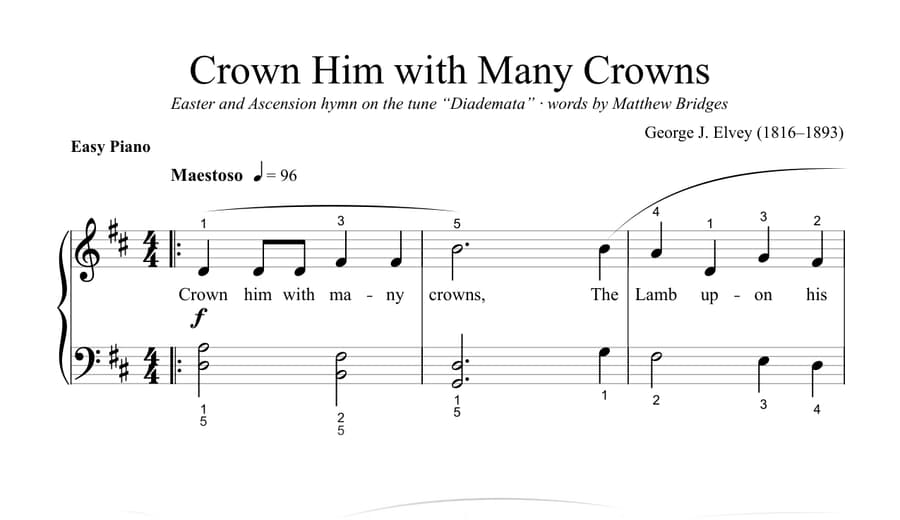
Crown Him with Many Crowns
-
George J. Elvey (1816–1893) · 2 pages · 0:50
Crown Him with Many Crowns for easy piano, with verse 1 lyrics, on George Elvey's tune 'Diademata', in D major. The right hand plays the melody as it is sung, the left hand plays the hymn's own bass line in single notes and open fifths, and there are no sixteenth notes. Fingering, dynamics and phrasing are marked. An optional repeat gives a second verse, and the piece closes with a soft echo of the last line.
Easy piano edition
Buy · US$6.99 from our shop
-
George J. Elvey (1816–1893) · 2 pages · 0:55
Crown Him with Many Crowns for the very first piano lessons, on George Elvey's tune 'Diademata', in C major. Every right-hand note has its letter name printed under it, the right hand plays the melody one note at a time in five-finger positions, and each place the hand has to move is marked "move". The left hand plays single bass notes or open fifths. Fingering, dynamics, phrasing and a simple tempo word are marked, with an optional repeat and a short ending.
Beginner piano, letter names edition
Buy · US$6.99 from our shop
-
George J. Elvey (1816–1893) · 4 pages · 1:40
Crown Him with Many Crowns as a piano duet for a student and teacher at one piano, on George Elvey's tune 'Diademata', in D major. The student (Primo) plays the easy-piano melody with fingering and verse 1 lyrics, printed an octave below where it sounds under an 8va line so it reads in the usual place. The teacher (Secondo) plays a full accompaniment on the hymn's own harmony, with a four-bar introduction, a different accompaniment for the second verse and a quiet close. Includes the full score and a separate part for each player.
Piano duet edition
Buy · US$6.99 from our shop
-
Sheet music to order
Need another piece, or another key?
A piece arranged at the level you ask for. A fixed price, quoted first.